Thursday, September 30, 2010

Sun Trivias


We have described the layers in the sun’s outer atmosphere, but have ignored some of their more interesting aspects, the storms in the atmosphere. The sun’s atmosphere is regularly disturbed by solar weather in the form of sunspots, prominences, and solar flares. With the proper equipment—or an Internet connection (http://sohowww.estec. esa.nl)—you can observe some of the signs of activity on the sun’s surface.
A Granulated Surface
If we look at the sun, its surface usually appears featureless, except, perhaps, for sunspots, which we’ll discuss in a moment. However, viewed at high-resolution, the surface of the sun actually appears highly granulated. Now, granule is a relative concept when we are talking about a body the size of the sun. Each granule is about the size of an earthly continent, appearing and disappearing as a hot gas bubble rises to the surface of the sun.
Galileo Sees Spots Before His Eyes
People must have seen sunspots before 1611, when Galileo (and, independently, other astronomers) first reported them. (As recently as March 2001, sunspots easily visible to the unaided eye have appeared.) The largest spots are visible to the naked eye (at least when the sun is seen through clouds). Yet, at the time, the world was reluctant to accept imperfections on the face of the sun.
Sunspots were not (as far as we know) studied before Galileo. Galileo drew a profound conclusion from the existence and behavior of sunspots. In 1613, he published three letters on sunspots, explaining that their movement across the face of the sun showed that the sun rotated.

What is Solar Wind


The sun does not keep its energy to itself. Its energy flows away in the form of electromagnetic radiation and particles. The particles (mostly electrons and protons) do not move nearly as fast as the radiation, which escapes the sun at the speed of light, but they move fast nevertheless—at more than 300 miles per second (500 km/s). It is this swiftly moving particle stream that is called the solar wind.
The solar wind is driven by the incredible temperatures in the solar corona. As a result, the gases are sufficiently hot to escape the tremendous gravitational pull of the sun. The surface of the earth is protected from this wind by its magnetosphere, the magnetic “cocoon” generated by the rotation of the earth’s molten core. As with many other planets, the motion of charged molten material in the earth’s core generates a magnetic field around the planet. This magnetic field either deflects or captures charged particles from the solar wind. Some of these particles are trapped in the Van Allen Belts, doughnut-shaped regions around the earth named after their discoverer. Some of the charged particles rain down on the earth’s poles and collide with its atmosphere, giving rise to displays of color and light called aurora (in the Northern Hemisphere the Aurora Borealis, or Northern Lights, and in the Southern Hemisphere, the Aurora Australis, or Southern Lights). The Auroras are especially prominent when the sun reaches its peak of activity every 11 years.

Understanding Solar Eclipse


A solar eclipse occurs when the moon moves across the disk of the sun so that the moon’s shadow falls across the face of the earth. In the heart of that shadow, called the umbra, the sun’s disk will appear completely covered by that of the moon: a total solar eclipse. The umbra, however, only falls on a small region of the earth. Thus a total eclipse can be observed only within the zone of totality, a very narrow area of the earth (where this shadow falls as the earth rotates). For this reason, total eclipses are rare events in any given geographical area. Much more common are partial eclipses, in which the moon obscures only part of the sun. Observers located in the much broader outer shadow of the moon (the penumbra) see such an eclipse.
Certainly, partial eclipses are interesting, but a total eclipse can be spectacular, not only dramatically darkening the world, but allowing sight of such solar features as feathery prominences, the chromosphere, and, most thrilling of all, the corona. These features are fleeting, since totality lasts only a few minutes at any one observing location. As mentioned elsewhere in this book, observing the sun directly is very dangerous.
Looking at the sun through an unfiltered telescope or binoculars will cause irreversible damage to your eyesight. The sun is no more or less dangerous during an eclipse than at any other time; but the point is that looking directly at the sun is always dangerous and harmful.
The sun, during an eclipse or at any time, is most safely observed by projecting its image onto a piece of paper or cardboard. You can project a telescope or binocular image onto a white card held at the correct distance from the eyepiece. But you don’t need a telescope or binoculars to project an image. Just make a pinhole in a stiff piece of cardboard and project the pinhole image onto a white card or paper. (By the way: Do not look
through the pinhole directly at the sun!)
If you want to look at the sun through your telescope during an eclipse or at another time, purchase a solar filter (glass or Mylar) from any of the major telescope manufacturers. This type of filter attaches to the front of your telescope tube, it does not screw onto the eyepiece.

Tuesday, August 31, 2010

A Luminous Crown


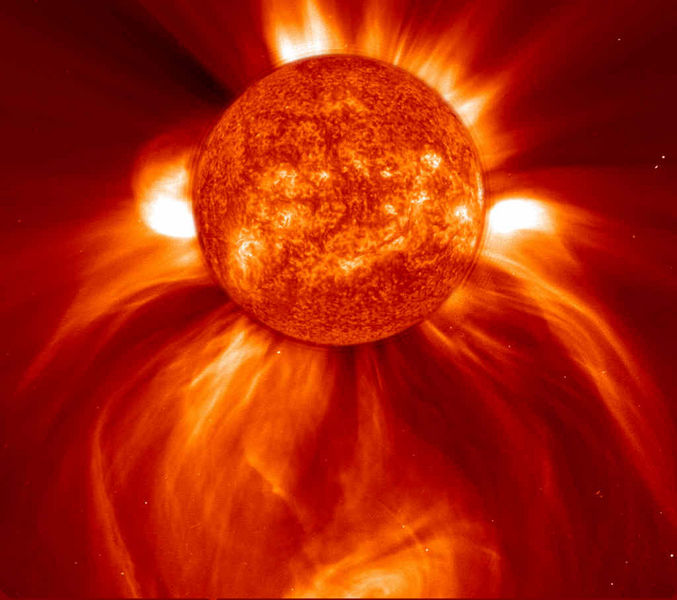
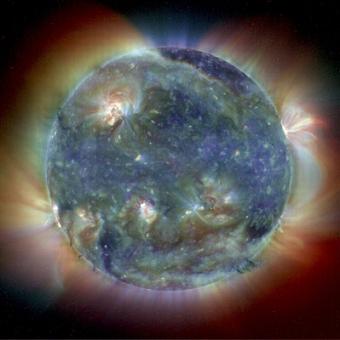
Corona is Latin for “crown,” and it describes the region beyond the transition zone consisting of elements that have been highly ionized (stripped of their electrons) by the tremendous heat in the coronal region. Like the chromosphere, the corona is normally invisible, blotted out by the intense light of the photosphere. It is only during total solar eclipses that the corona becomes visible, at times when the disk of the moon covers the photosphere and the chromosphere. During such eclipse conditions, the significance of the Latin name becomes readily apparent: The corona appears as a luminous crown surrounding the darkened disk of the sun. When the sun is active—a cycle that peaks every 11 years—its surface becomes mottled with sunspots, and great solar flares and prominences send material far above its surface.

Not That Kind of Chrome


The sun’s lower atmosphere is called the chromosphere, normally invisible because the photosphere is far brighter. However, during a total solar eclipse, which blots out the photosphere, the chromosphere is visible as a pinkish aura around the solar disk. The strongest emission line in the hydrogen spectrum is red, and the predominance of hydrogen in the chromosphere imparts the pink hue. The chromosphere is a storm-racked region, into which spicules, jets of expelled matter thousands of miles high, intrude.
Above the chromosphere is the transition zone. As mentioned earlier, the temperature at the surface of the photosphere is 5,780 K, much cooler than the temperatures in the solar interior, which get hotter the closer one approaches the core. Yet, in the chromosphere, transition zone, and into the corona, the temperature rises sharply the farther one goes from the surface of the sun! At about 6,000 miles (10,000 km) above the photosphere, where the transition zone becomes the corona, temperatures exceed 1,000,000 K. (For detailed real-time views of the solar photosphere, chromosphere, and corona, see http://sohowww.estec.esa.nl.) How do we explain this apparent paradox? It is believed that the interaction between the sun’s strong magnetic field and the charged particles in the corona heat it to these high temperatures.

The Solar Atmosphere


The sun does not have a surface as such. What we call its surface is just the layer that emits the most light. Let’s begin our journey at the outer layers of the sun (the layers that we can actually see), and work our way in. When you look up at the sun during the day, what you are really looking at is the sun’s photosphere. The layer from which the visible photons that we see arise, the photosphere has a temperature of about 6,000 K. Lower layers are hidden behind the photosphere, and higher layers are so diffuse and faint (though very hot) that we only see them during total solar eclipses or with special satellites. Above the photosphere in the solar atmosphere are the chromosphere, the transition zone, and the corona. As we move higher in the sun’s atmosphere, the temperatures rise dramatically.

Saturday, July 31, 2010

Four Trillion Trillion Light Bulbs


Next time you are screwing in a light bulb, notice its wattage. A watt is a measure of power, or how much energy is produced or consumed each second. A 100 watt bulb uses 100 joules of energy every second. For comparison, the sun produces 4 1026 watts of power. That’s a lot of light bulbs—four trillion trillion of them, to be exact. This rate of energy production is called the sun’s luminosity. Many stars have luminosities much higher than that of the sun.
The source of the sun’s power—and that of all stars, during most of their lifetimes—is the fusing together of nuclei. Stars first convert hydrogen into helium, and heavier elements come later. The only fusion reactions that we have been able to produce on the earth are uncontrolled reactions known as hydrogen bombs. The destructive force of these explosions gives insight into the enormous energies released in the core of the sun. Nuclear fusion could be used as a nearly limitless supply of energy on the earth; however, we are not yet able to create the necessary conditions on Earth for controlled fusion reactions.