
Tuesday, November 30, 2010
Chain Reactions in the Sun
The sun generates energy by the converting the hydrogen in its core to helium. The details are complex, but we may content ourselves with an overview. When temperatures and pressures are sufficiently high (temperatures of about 10 million K are required) 4 hydrogen nuclei (which are protons, positively charged particles) can combine to create the nucleus of a helium atom (2 protons and 2 neutrons). Now the mass of the helium nucleus created is slightly less than that of the four protons that were needed to create it. That small difference in mass is converted into energy in the fusion process. One of the simplest fusion reactions involves the production of deuterium (a hydrogen isotope) from a proton and a neutron. When these two particles collide with enough velocity, they create a deuterium nucleus (consisting of a proton and a neutron) and the excess energy is given off as a gamma ray photon. In the sun, this process proceeds on a massive scale, liberating the energy that lights up our daytime skies. That’s a 4 ×1026 watt lightbulb up there, remember.

Fission in the Sun
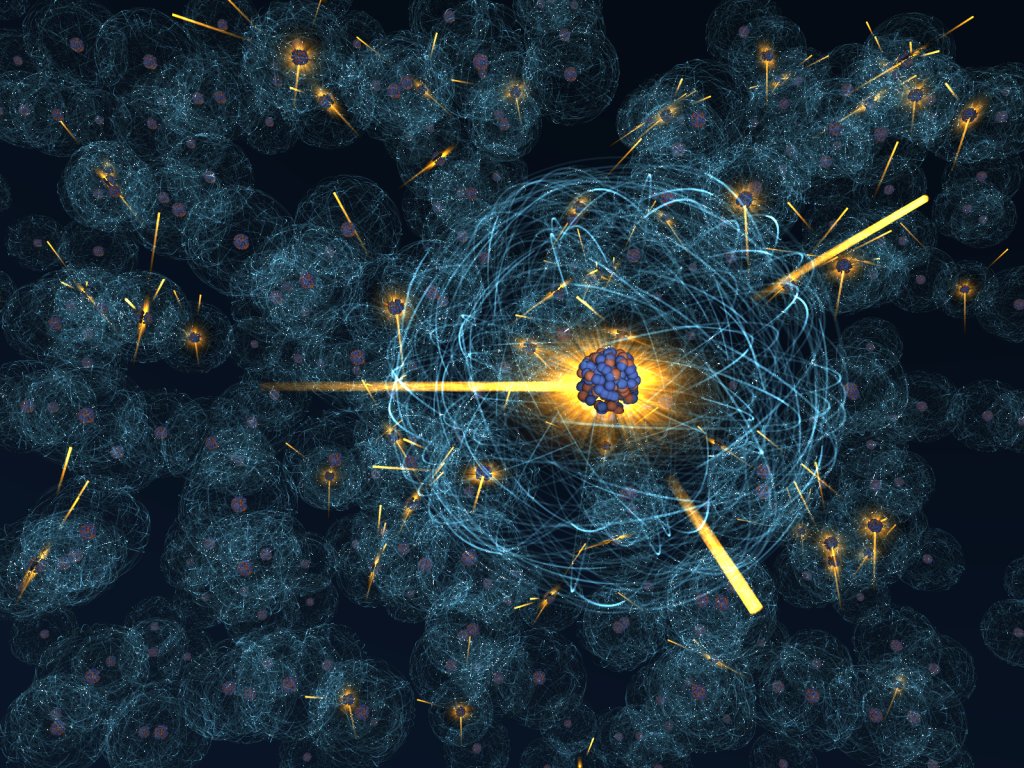
On December 2, 1942, Enrico Fermi, an Italian physicist who had fled his fascistoppressed native land for the United States, withdrew a control rod from an “atomic pile” that had been set up in a squash court beneath the stands of the University of Chicago’s Stagg Field. This action initiated the world’s first self-sustaining atomic chain reaction. Fermi and his team had invented the nuclear reactor, and the world hasn’t been the same since.
Nuclear fission is a nuclear reaction in which an atomic nucleus splits into fragments, thereby releasing energy. In a fission reactor, such as the one Fermi was instrumental in creating, the process of fission is controlled and self-sustaining, so that the splitting of one atom leads to the splitting of others, each fission liberating more energy.
Nuclear fission is capable of liberating a great deal of energy, whether in the form of a controlled sustained chain reaction or in a single great explosion, like an atomic bomb. Yet even the powerful fission process cannot account for the tremendous amount of energy the sun generates so consistently. We must look to another process: nuclear fusion.
Whereas nuclear fission liberates energy by splitting atomic nuclei, nuclear fusion produces energy by joining them, combining light atomic nuclei into heavier ones. In the process, the combined mass of two nuclei in a third nucleus is less than the total mass of the original two nuclei. The mass is not simply lost, but converted into energy. A lot of energy. One of the by-products of nuclear fusion reactions is a tiny neutral particle called the neutrino. The fusion reactions themselves produce high energy gamma ray radiation, but those photons are converted into mostly visible light by the time their energy reaches the surface of the sun. Neutrinos, with no charge to slow them down, come streaming straight out of the sun’s core. The numbers that we detect give us great insight into a region of the sun that is otherwise inaccessible.
Sunday, October 31, 2010
Solar flares
 Most frequently at the peak of the sunspot cycle, violent eruptions of gas are ejected from the sun’s surface. The prominences and flares may rise to some 60,000 miles (100,000 km) and may be visible for weeks. Solar flares are more sudden and violent events than prominences. While they are thought to also be the result of magnetic kinks, they do not show the arcing or looping pattern characteristic of prominences. Flares are explosions of incredible power, bringing local temperatures to 100,000,000 K. Whereas prominences release their energy over days or weeks, flares explode in a flash of energy release that lasts a matter of minutes or, perhaps, hours.
Understanding Sunspot Cycles

Long before the magnetic nature of sunspots was perceived, astronomer Heinrich Schwabe, in 1843, announced his discovery of a solar cycle, in which the number of spots seen on the sun reaches a maximum about every 11 years (on average). In 1922, the British astronomer Annie Russel Maunder charted the latitude drift of sunspots during each solar cycle. She found that each cycle begins with the appearance of small spots in the middle latitudes of the sun, followed by spots appearing progressively closer to the solar equator until the cycle reaches its maximum level of activity. After this point, the number of spots begins to decline. The most recent maximum occured in early 2001.
Actually, the 11-year period is only half of a 22-year cycle that is more fundamental. Recall that the leading spots on one hemisphere exhibit the same polarity; that is, they are all either north magnetic poles or south (and the followers are the opposite of the leaders). At the end of the first 11 years of the cycle, polarities reverse. That is, if the leaders had north poles in the southern hemisphere, they become, as the second half of the cycle begins, south poles.
The cyclical nature of sunspot activity is very real, but not exact and inevitable. Studying historical data, Maunder discovered that the cycle had been apparently dormant from 1645 to 1715. At present, there is no explanation for this dormancy and other variations in the solar cycle.
Sunspots: What They Are
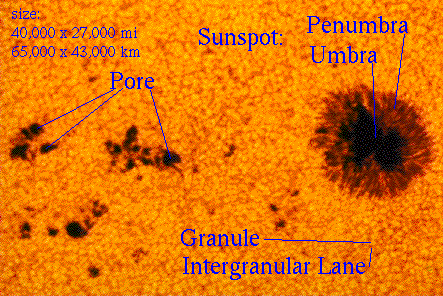
Sunspots are irregularly shaped dark areas on the face of the sun. They look dark because they are cooler than the surrounding material. The strong local magnetic fields push away some of the hot ionized material rising from lower in the photosphere. A sunspot is not uniformly dark. Its center, called the umbra, is darkest and is surrounded by a lighter penumbra. If you think of them as blemishes on the face of the sun, just remember that one such blemish may easily be the size of the earth or larger.
Sunspots may persist for months, and they may appear singly, although, usually, they are found in pairs or groups. Such typical groupings are related to the magnetic nature of the sunspots. Every pair of spots has a leader and a follower (with respect to the direction of the sun’s rotation), and the leader’s magnetic polarity is always the opposite of the follower. That is, if the leader is a north magnetic pole, the follower will be a south magnetic pole.
Sunspots are never seen exactly at the equator or near the solar poles, and leaders and followers in one hemisphere of the sun are almost always opposite in polarity from those across the equator. That is, if all the leaders in the northern hemisphere are south magnetic poles, all the leaders in the southern hemisphere will be north magnetic poles.
We have said that sunspots are thought to be associated with strong local magnetic fields. But why are the fields strong in certain regions of the photosphere? A meteorologist from Norway, Vilhelm Bjerknes (1862–1951) concluded in 1926 that sunspots are the erupting ends of magnetic field lines, which are distorted by the sun’s differential rotation. That is, like the gas giant jovian worlds, the sun does not rotate as a single, solid unit, but differentially, at different speeds for different latitudes. The sun spins fastest at its equator—the result being that the solar magnetic field becomes distorted. The field lines are most distorted at the equator, so that the north-south magnetic field is turned to an east-west orientation. In places where the field is sufficiently distorted, twisted like a knot, the field becomes locally very strong, powerful enough to escape the sun’s gravitational pull. Where this happens, field lines “pop” out of the photosphere, looping through the lower solar atmosphere and forming a sunspot pair at the two places where the field lines pass into the solar interior.
Thursday, September 30, 2010
Sun Trivias

We have described the layers in the sun’s outer atmosphere, but have ignored some of their more interesting aspects, the storms in the atmosphere. The sun’s atmosphere is regularly disturbed by solar weather in the form of sunspots, prominences, and solar flares. With the proper equipment—or an Internet connection (http://sohowww.estec. esa.nl)—you can observe some of the signs of activity on the sun’s surface.
A Granulated Surface
If we look at the sun, its surface usually appears featureless, except, perhaps, for sunspots, which we’ll discuss in a moment. However, viewed at high-resolution, the surface of the sun actually appears highly granulated. Now, granule is a relative concept when we are talking about a body the size of the sun. Each granule is about the size of an earthly continent, appearing and disappearing as a hot gas bubble rises to the surface of the sun.
Galileo Sees Spots Before His Eyes
People must have seen sunspots before 1611, when Galileo (and, independently, other astronomers) first reported them. (As recently as March 2001, sunspots easily visible to the unaided eye have appeared.) The largest spots are visible to the naked eye (at least when the sun is seen through clouds). Yet, at the time, the world was reluctant to accept imperfections on the face of the sun.
Sunspots were not (as far as we know) studied before Galileo. Galileo drew a profound conclusion from the existence and behavior of sunspots. In 1613, he published three letters on sunspots, explaining that their movement across the face of the sun showed that the sun rotated.
What is Solar Wind

The sun does not keep its energy to itself. Its energy flows away in the form of electromagnetic radiation and particles. The particles (mostly electrons and protons) do not move nearly as fast as the radiation, which escapes the sun at the speed of light, but they move fast nevertheless—at more than 300 miles per second (500 km/s). It is this swiftly moving particle stream that is called the solar wind.
The solar wind is driven by the incredible temperatures in the solar corona. As a result, the gases are sufficiently hot to escape the tremendous gravitational pull of the sun. The surface of the earth is protected from this wind by its magnetosphere, the magnetic “cocoon” generated by the rotation of the earth’s molten core. As with many other planets, the motion of charged molten material in the earth’s core generates a magnetic field around the planet. This magnetic field either deflects or captures charged particles from the solar wind. Some of these particles are trapped in the Van Allen Belts, doughnut-shaped regions around the earth named after their discoverer. Some of the charged particles rain down on the earth’s poles and collide with its atmosphere, giving rise to displays of color and light called aurora (in the Northern Hemisphere the Aurora Borealis, or Northern Lights, and in the Southern Hemisphere, the Aurora Australis, or Southern Lights). The Auroras are especially prominent when the sun reaches its peak of activity every 11 years.
Subscribe to:
Posts (Atom)
