
 If you’ve ever been outside late at night looking to the south, chances are you’ve already seen the largest planet in the solar system, Jupiter. You may have thought that it was just a bright star, and that is exactly what the ancients thought, except that they realized it moved in a way unlike the other stars. Imagine Galileo’s surprise, then, in 1610, when he pointed a telescope at the planet and saw its surface and four smaller bodies orbiting it. His discovery would cause a good deal of upheaval in the way humans viewed themselves in the universe, and Galileo himself would end up in trouble with the Church. All this because of that wandering star in the sky. All of the planets are found near an imaginary arc across the sky that we call the ecliptic. Long before astronomers knew that the terrestrial planets shared common features, they knew that two of the “wanderers” that they watched were different. While Mercury and Venus never strayed far from the sun, and Mars moved in a fairly rapid path across the sky, Jupiter and Saturn moved ponderously, majestically across the stellar ocean. In that motion, we had a clue that the outer planets—those farthest from the sun—were unique long before we had telescopes. Mercury, Venus, and Mars may seem inhospitable, forbidding, and downright deadly, but our sister terrestrial planets have more in common with the earth than the giants of the solar system’s farthest reaches. The jovian planets are truly other-worldly, many times larger and more massive than the earth, yet less dense: They are balls of gas that coalesced around a dense core, accompanied by multiple moons and even rings. In recent years, thanks to the Hubble Space Telescope and planetary probes such as the Voyagers and Galileo, the jovian planets and their moons have given up some of their mysteries.
Saturday, October 31, 2009
Understanding gas planets
If you’ve ever been outside late at night looking to the south, chances are you’ve already seen the largest planet in the solar system, Jupiter. You may have thought that it was just a bright star, and that is exactly what the ancients thought, except that they realized it moved in a way unlike the other stars. Imagine Galileo’s surprise, then, in 1610, when he pointed a telescope at the planet and saw its surface and four smaller bodies orbiting it. His discovery would cause a good deal of upheaval in the way humans viewed themselves in the universe, and Galileo himself would end up in trouble with the Church. All this because of that wandering star in the sky. All of the planets are found near an imaginary arc across the sky that we call the ecliptic. Long before astronomers knew that the terrestrial planets shared common features, they knew that two of the “wanderers” that they watched were different. While Mercury and Venus never strayed far from the sun, and Mars moved in a fairly rapid path across the sky, Jupiter and Saturn moved ponderously, majestically across the stellar ocean. In that motion, we had a clue that the outer planets—those farthest from the sun—were unique long before we had telescopes. Mercury, Venus, and Mars may seem inhospitable, forbidding, and downright deadly, but our sister terrestrial planets have more in common with the earth than the giants of the solar system’s farthest reaches. The jovian planets are truly other-worldly, many times larger and more massive than the earth, yet less dense: They are balls of gas that coalesced around a dense core, accompanied by multiple moons and even rings. In recent years, thanks to the Hubble Space Telescope and planetary probes such as the Voyagers and Galileo, the jovian planets and their moons have given up some of their mysteries.

Martian Moons
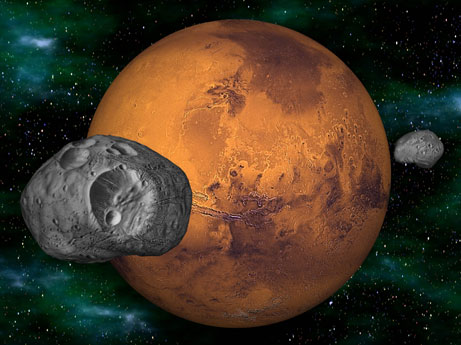
Mars and Earth are the only terrestrial planets with moons. As we have said, the earth’s moon is remarkably large, comparable in size to some of the moons of Jupiter. The moons of Mars, colorfully named Phobos (Fear) and Deimos (Panic), after the horses that drew the chariot of the Roman war god, were not discovered until 1877. They are rather unimpressive as moons go, resembling large asteroids. They are small and irregularly shaped (Phobos is 17.4 miles long 12.4 miles [28 km 20 km] wide, and Deimos is 10 miles 6.2 miles [16 km 10 km]). They are almost certainly asteroids that were gravitationally captured by the planet and fell into orbit around it.
Wednesday, September 30, 2009
Water in Mars
 Clearly visible on images produced by Martian probes are runoff and outflow channels,
which are believed to be dry river beds, evidence that water once flowed as a liquid
on Mars. Geological evidence dates the Martian highlands to four billion years
ago, the time in which water was apparently sufficiently plentiful to cause widespread
flooding. Recent theories suggest that at the time, Mars had a thicker atmosphere that
allowed water to exist in a liquid state, even at its low surface temperatures.
The Mars Global Surveyor mission, which has established an orbit around the red
planet and is transmitting early data back to the earth, has found further geological
evidence for the presence of liquid and subsurface water. Such evidence has kept alive
hopes that life may have existed—or may even yet exist, perhaps on a microbial
level—on Mars.
Volcanoes, Craters, and a “Grand Canyon”

The Mariner series of planetary probes launched in the 1960s and 1970s revealed a startling difference between the southern and northern hemispheres of Mars. The southern hemisphere is far more cratered than the northern hemisphere, which is covered with wind-blown material as well as volcanic lava. There have even been recent proposals that the smooth northern hemisphere hides a frozen ocean.
Volcanoes and lava plains from ancient volcanic activity abound on Mars. Because the planet’s surface gravity is low (0.38 that of the earth), the volcanoes can rise to spectacular heights. Like Venus, Mars lacks a strong magnetic field, but, in contrast to Venus, it rotates rapidly; therefore, astronomers conclude that the core of Mars is nonmetallic, nonliquid, or both. Astronomers believe that the core of the smaller Mars has cooled and is likely solid, consisting largely of iron sulfide.
Unlike the earth, Mars failed to develop much tectonic activity (instability of the crust), probably because its smaller size meant that the outer layers of the planet cooled rapidly. Instead, volcanic activity was probably quite intense some 2 billion years ago.
Also impressive are Martian canyons, including Valles Marineris, the “Mariner
Valley,” which runs some 2,500 miles (4,025 km) along the Martian equator and is as
much as 75 miles (120 km) wide and, in some places, more than four miles (6.5 km)
deep. The Valles Marineris is not a canyon in the earthly sense, since it was not cut
by flowing water, but is a geological fault feature.
Why Mars Is Red
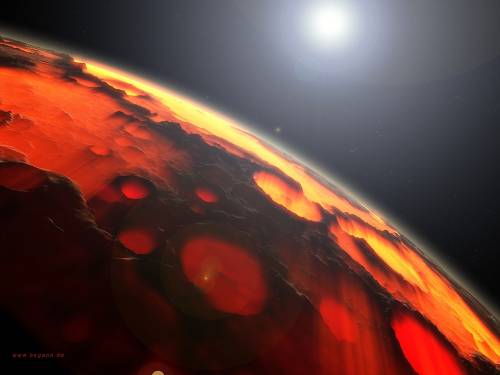
If we feel any disappointment at the loss of our cherished Martian canals, at least we can still enjoy the image of the “angry red planet.” Yet the source of the reddish hue is not the bloody spirit of the Roman god of war, but simple iron ore. The Martian surface contains large amounts of iron oxide, red and rusting. As Viking 1 and Mars Pathfinder images revealed, even the Martian sky takes on a rust-pink tinge during seasonal dust storms.
The dust is blown about by winds that kick up in the Martian summer. These winds play a prominent role on Mars, forming vast dunes and streaking craters. An especially large dune is found around the north polar cap.
Monday, August 31, 2009
The Martian Chronicles

Percival Lowell was born in Boston in 1855, son of one of New England’s wealthiest and most distinguished families. His early career was absorbed in literature (his sister Amy Lowell became a famous poet) and Far Eastern travel. He became a diplomat, serving as counselor and foreign secretary to the Korean Special Mission to the United States. But in the 1890s, he read a translation of an 1877 book by Giovanni Schiaparelli, the same Italian astronomer who had concluded that Mercury’s rotation was synchronized with its orbit. Reporting his observations of the surface of Mars, Schiaparelli mentioned having discovered canali.
The word, which means nothing more than “channels” in Italian, was mistranslated as “canals” in what Lowell read, and the budding astronomer, already charmed by exotic places, set off in quest of the most exotic of all: Mars—and whatever race of beings had excavated canals upon it.
Lowell dedicated his considerable family fortune to
the study of the planet Mars. He built a private observatory in Flagstaff, Arizona, and, after years of observation, published Mars and Its Canals in 1906. Noting that the canal network underwent seasonal changes, growing darker in the summer, Lowell theorized that technologically sophisticated beings had created the canals to transport crop irrigation water from the Martian polar ice caps. In 1924, astronomers searched for radio signals from the planet (using a technique that anticipated the current search for radio signals from the universe), but to no avail. Yet the idea of intelligent life on Mars was so ingrained in the public imagination that, on October 30, 1938, Orson Welles’s celebrated radio adaptation of H. G. Wells’s 1898 science fiction novel about an invasion from Mars, War of the Worlds, triggered national panic. A variety of space probes have now yielded very high resolution images of Mars, revealing the apparent canals as natural features, such as craters and canyons. While it is true that Mars undergoes seasonal changes, the ice caps consist of a combination of frozen carbon dioxide and water.
Mars: “That Looks Like New Mexico!”
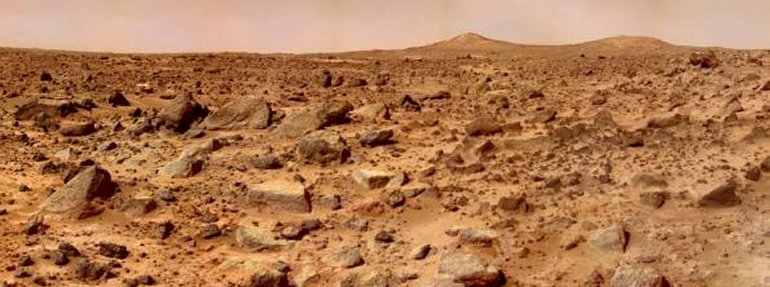
Those of us who were glued to our television sets when NASA shared images of the Martian surface produced by the Mars Pathfinder probe were struck by the resemblance of the landscape to the earth. Even the vivid red coloring of the rocky soil seems familiar to anyone who has been to parts of Australia or even the state of Georgia—though the general landscape, apart from its color, more closely resembles desert New Mexico.
In contrast to Mercury and Venus, which are barely inclined on their axes (in fact, their axes are almost perpendicular to their orbital planes), Mars is inclined at an angle of 25.2 degrees—quite close to the earth’s inclination of 23.5 degrees. And that’s only one similarity. While Mercury and Venus move in ways very different from the earth, Mars moves through space in ways that should seem quite familiar to us. It rotates on its axis once in every 24.6 hours—a little more than an Earth day—and because it is inclined much as the earth is, it also experiences familiar seasonal cycles.
The peculiarities of Mercury and Venus make Mars look more similar to the earth than it really is. Generations have looked to the red planet as a kind of solar system brother, partly believing, partly wishing, partly fearing that life might be found there. But the fact is that life as it exists on Earth cannot exist on the other terrestrial planets.
Subscribe to:
Posts (Atom)
