
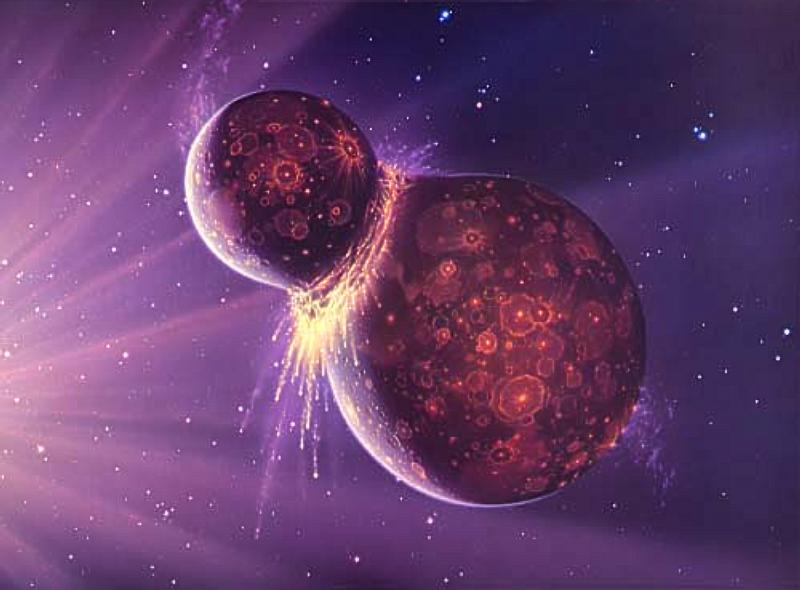
The favored theory today combines elements of the daughter theory and the capture theory in something called an impact theory. Most astronomers now believe that a very large object, roughly the size of Mars, collided with the earth when it was still molten and forming. Assuming the impact was a glancing one, it is suggested that shrapnel from the earth and the remnant of the other planetesimal (a planet in an early stage of formation) were ejected and then slowly coalesced into a stable orbit that formed the moon.
This model is also popular because it can explain some unusual aspects of the earth (the “tip” of its rotational axis, perhaps) and the moon. In the impact model, it is further theorized that most of the iron core of the Mars-sized object would have been left behind on the earth, eventually to become part of the earth’s core, while the material that would coalesce into the moon acquired little of this metallic core. This model can explain why the earth and moon share similar mantles (outer layers), but apparently differ in core composition.


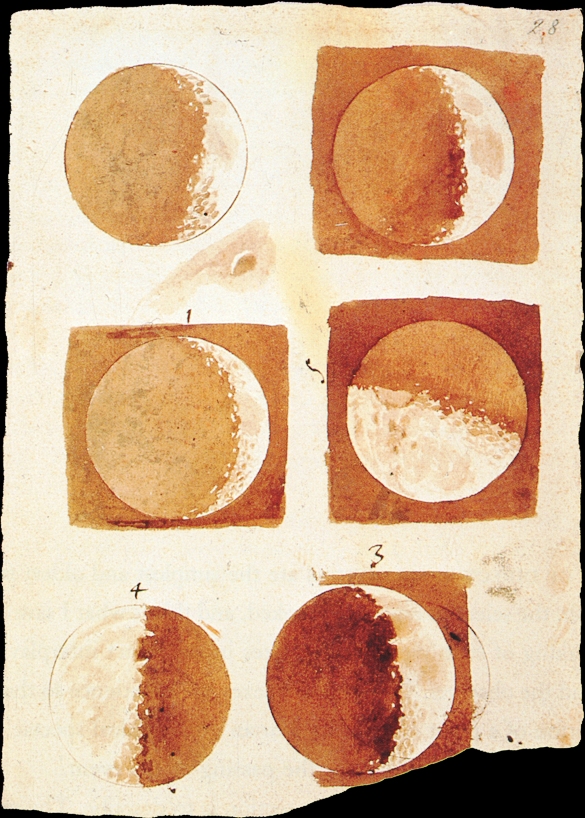
 Take the time to observe the moon through all of its phases. When the moon is about three or four days “old,” Mare Crisium and other vivid features—including the prominent craters Burckhardt and Geminus—become dramatically visible, assuming it’s a clear night. You can also begin to see Mare Tranquilitatis, the Sea of Tranquility.
 It is possible to observe many features of the moon without a telescope. One of the first things you should try is to track its daily motion against the background stars. Since the moon travels around the earth (360 degrees) in