
 While countless human beings have gazed up at the sky with wonder, a few were never content just to look. They didn’t want to wait for the information to get here, they wanted to go there. In the second century C.E., the Greek satirist Lucian wrote the first account we have of a fictional trip from the earth to the moon. Doubtless, someone had thought about such a trip before Lucian, and certainly many contemplated space travel after him. It was not until the eighteenth century that people were first lofted into the air by hot-air balloons. And while the airplane made its debut in 1903, human spaceflight—in which a human ventured beyond the earth’s protective atmospheric blanket—did not come about until the 1961 flight of a Soviet cosmonaut Yuri Alekseyevich Gagarin.
Sunday, July 13, 2008
The Space Race
While countless human beings have gazed up at the sky with wonder, a few were never content just to look. They didn’t want to wait for the information to get here, they wanted to go there. In the second century C.E., the Greek satirist Lucian wrote the first account we have of a fictional trip from the earth to the moon. Doubtless, someone had thought about such a trip before Lucian, and certainly many contemplated space travel after him. It was not until the eighteenth century that people were first lofted into the air by hot-air balloons. And while the airplane made its debut in 1903, human spaceflight—in which a human ventured beyond the earth’s protective atmospheric blanket—did not come about until the 1961 flight of a Soviet cosmonaut Yuri Alekseyevich Gagarin.
Chandrasekhar and the X-Ray Revolution

Electromagnetic radiation at the highest end of the spectrum can now be studied. Since x-rays and gamma rays cannot penetrate our atmosphere, all of this work must be done by satellite. Work began in earnest in 1978 when an x-ray telescope was launched, called the High-Energy Astronomy Observatory (later, the Einstein Observatory). The Röentgen Satellite (ROSAT) was next launched by Germany in 1990. The Chandra X-ray Observatory (named for astronomer Subrahmanyah Chandrasekhar) was launched into orbit in July 1999 and has produced unparalleled high-resolution images of the x-ray universe. The Chandra image of the Crab Nebula, home to a known pulsar, showed never before seen details of the environment of an exploded star. For recent images, go to www.chandra.harvard.edu. X-rays are detected from very high energy sources, such as the remnants of exploded stars (supernova remnants) and jets of material streaming from the centers of galaxies. Chandra is the premier x-ray instrument, doing in this region of the spectrum what the Hubble Space Telescope has done for optical observations.
In 1991, the Gamma Ray Observatory (GRO) was launched by the space shuttle. It is revealing unique views of the cosmos, especially in regions where the energies involved are very high: near black holes, at the centers of active galaxies, and near neutron stars.
New Infrared and Ultraviolet Observations

Telescopes need to be specially equipped to detect infrared radiation—the portion of the spectrum just below the red end of visible light. Infrared observatories have applications in almost all areas of astronomy, from the study of star formation, cool stars, and the center of the Milky Way, to active galaxies, and the large-scale structure of the universe. IRAS (the Infrared Astronomy Satellite) was launched in 1983 and sent images back to Earth for many years. Like all infrared detectors, though, the ones on IRAS had to be cooled to low temperatures so that their own heat did not overwhelm the weak signals that they were trying to detect. Although the satellite is still in orbit, it has long since run out of coolant, and can no longer make images. The infrared capability of the Hubble Space Telescope provided by NICMOS (Near-Infrared Camera and Multi-Object Spectograph) yielded spectacular results while in operation. The Next-Generation Space Telescope (NGST) will be optimized to operate at infrared wavelengths, and will be cooled passively (by a large solar shield).
Ultraviolet radiation, which begins in the spectrum at frequencies higher than those of visible light, is also being studied with new telescopes. Since our atmosphere blocks all but a small amount of ultraviolet radiation, ultraviolet studies must be made by high-altitude balloons, rockets, or orbital satellites. The Hubble Space Telescope, for instance, has the capability to detect ultraviolet (UV) photons as well as those with frequencies in the visible and infrared. Ultraviolet observations provide our best views of stars, and stars with surface temperatures higher than the sun’s.
What is SETI?
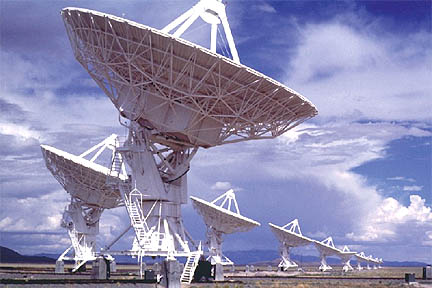
If you’ve seen such sci-fi movies as The Arrival, Independence Day, or Contact, you already know about an organization called SETI (Search for Extra-Terrestrial Intelligence). It is an international group of scientists and others who, for the most part, use radio telescopes to monitor the heavens in search of radio signals generated not by natural phenomena, but broadcast artificially by intelligent beings from other worlds. So far, no clearly artificial extraterrestrial radio signals have been confirmed, but SETI personnel keep searching. The SETI project got a large boost recently when Paul Allen, one of the co-founders of Microsoft, committed $12.5 million to the project. The new instrument to be built exclusively for SETI will be called the Allen Telescope Array.
If you are interested in the search for extraterrestrial intelligence, you don’t have to just read about it, you can actually participate in it. A few highly committed amateur radio astronomers have built SETI-capable radio telescopes and spend time searching for artificial signals of extraterrestrial origin. If you’re not up to making such a commitment, the SETI Institute is developing an alternative. In a project called SETI@home, a special kind of screensaver program (a program that, typically, puts up a pretty, animated picture on your PC monitor when the computer is idle) has been installed on over 1.5 million computers in 224 countries. When the computer is idle, this program will use the time to go to work analyzing data from four million different combinations of frequency bandwidth and drift rate recorded by the world’s largest radio telescope at Arecibo, Puerto Rico. With thousands of computers crunching this data, the SETI Institute believes that it can analyze data more quickly, thereby increasing the chances of ferreting out a radio signal from an intelligent source. Information on SETI@home can be found on the Net at www.seti-inst.edu.
Solar Flares and Meteor Events

Solar flares, are explosive events that occur in or near an active region on the sun’s surface. Flares can be detected with a very low frequency (VLF) receiver operating in the 20- to 100-KHz (kilohertz, or thousand hertz) band. (This is below the region of the spectrum where AM radio stations broadcast.) Such a receiver can be homemade, using plans supplied by such organizations as SARA. Solar flares can also be monitored in regular shortwave radio bands with a standard shortwave receiver. Why do solar flares create radio signals? They generate x-rays that strike a part of our atmosphere called the ionosphere, greatly enhancing the electron count in this atmospheric region. These electrons generate the noise picked up by the radio.
Saturday, June 28, 2008
Amateur Radio Astronomy: No-Cost and Low-Cost Approaches
A decent optical telescope costs at least $300 to $400. For free optical astronomy, all you need are your eyes. You can also do some radio astronomy for free—if you own an FM radio or a television set. We thank Tom Crowley of Atlanta Astronomy Club for many of the following ideas. Even they are affordable, don't drop it, because it breaks easily. If that's happen then I'll send you a nice condolence letter.
Have you ever witnessed a meteor shower? The streaks of light in the night sky can be quite spectacular.
Meteors are the bright trails of ionized atmosphere behind tiny bits of cometary debris that enter the earth’s atmosphere. Most meteorites are no larger than a pea. What if we told you that there was another way to watch a meteor shower—using a radio telescope otherwise known as an FM radio?
Meteor counts by radio are about ten times more accurate than visual observation—and, as with any radio observations, you can observe during the day or through clouds. It doesn’t have to be dark or clear outside. You may want to supplement your optical meteor gazing with your radio on cloudy nights.
Recall that the earth’s atmosphere is transparent to some forms of electromagnetic radiation and opaque to others. The upper atmosphere normally reflects low-frequency AM radio signals. In contrast, the atmosphere is transparent to higher frequency FM radio waves, which, as a consequence, have a shorter range. They usually penetrate and are not reflected by the atmosphere.
But something happens when a meteorite enters the atmosphere. Each piece of debris that tears into the atmosphere (at up to 40 miles per second), heats up the air around it and creates a tiny ionized (electrically charged) vapor trail in the upper atmosphere. These columns of charged particles can reflect even higher frequency FM radio waves. This temporary condition means that previously out-of-range FM broadcasts can (for a moment) be heard. During periods of known meteoric activity, stay at the low end of the FM dial and try to find FM radio stations that are from 400 to 1,300 miles away. You might call a distant friend to get the broadcast frequency of a few stations. When a distant station fades in for a second or two, you are indirectly observing a meteor. The trail behind it has momentarily reflected a distant radio signal into your receiver. It helps if you can hook up your radio to an outdoor antenna, but if the meteor shower is fairly intense, you should detect many events even without such an antenna. You can also try tuning your TV set to the lowest unused VHF channel. Again, when a distant station, normally out of range, fades in and the signal becomes strong for a second or two, you know a meteor has entered the atmosphere. (Note that this works only with a television receiving signals from an outdoor antenna—not via cable or satellite!)
Just by tuning in your radio, you can do some meaningful radio astronomy. You can make it more interesting by recording the events on tape, or keeping a written record of the number of events you detect per hour.
But amateur radio astronomy need not be limited to listening for distant FM radio or TV stations. If you are an amateur radio operator—a ham—you already have much of the equipment required for more serious radio astronomy. If you aren’t into amateur radio, you can get started for a highly variable but modest cost. The first step to take is to log onto SARA’s World Wide Web site (www.bambi.net/sara.html) for overview information.
Essentially, amateurs can use either nonimaging or imaging radio astronomy techniques. Nonimaging techniques (which monitor radio emissions without pinpointing locations) require a simple shortwave receiver, usually modified to receive a narrow band of frequencies, and a simple antenna system. With such equipment, you can track radio emission from Jupiter, solar flares, and meteor events. Imaging techniques (which provide more detailed information on the location and nature of the signal) require a more serious commitment of resources, including a much larger dish-type antenna, more sophisticated receiving equipment, reasonably elaborate recording equipment, and (probably) a rural location removed from most sources of radio interference. For purposes of this blog, we’ll restrict ourselves to the more approachable nonimaging techniques, which are more appropriate for beginners.
You Can Do This, Too!
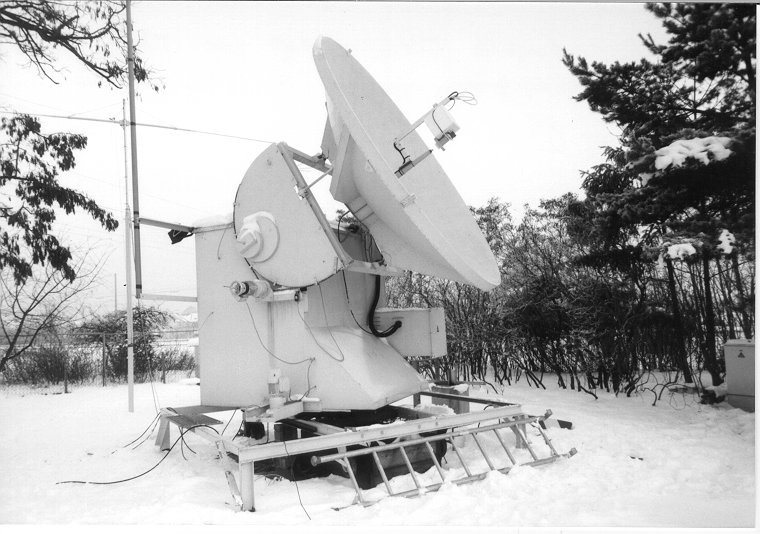
Building a huge radio telescope like Arecibo or the Green Bank Telescope (GBT) takes a great deal of money, and so does operating one. Even if you had the cash, your neighbors (not to mention the local zoning board), might frown on your building even a modest 30-foot-diameter dish antenna in your backyard. However, remember that radio astronomy originated with non-astronomers, and there is still plenty of room in the field for amateurs, including amateurs of modest means. You can see the sky just like an ancient Aztec astronomer. A small but committed group of enthusiasts have formed the Society of Amateur Radio Astronomers (SARA). Most books for budding astronomers don’t discuss amateur radio astronomy, though it is a fascinating and rewarding subject.
Subscribe to:
Posts (Atom)
